Testing Shared UI Components Without Testing Every Page Twice
Reusing a UI component does not mean testing every page identically. A practical coverage map shows which behaviors belong in component, integration and browser tests.
On this page
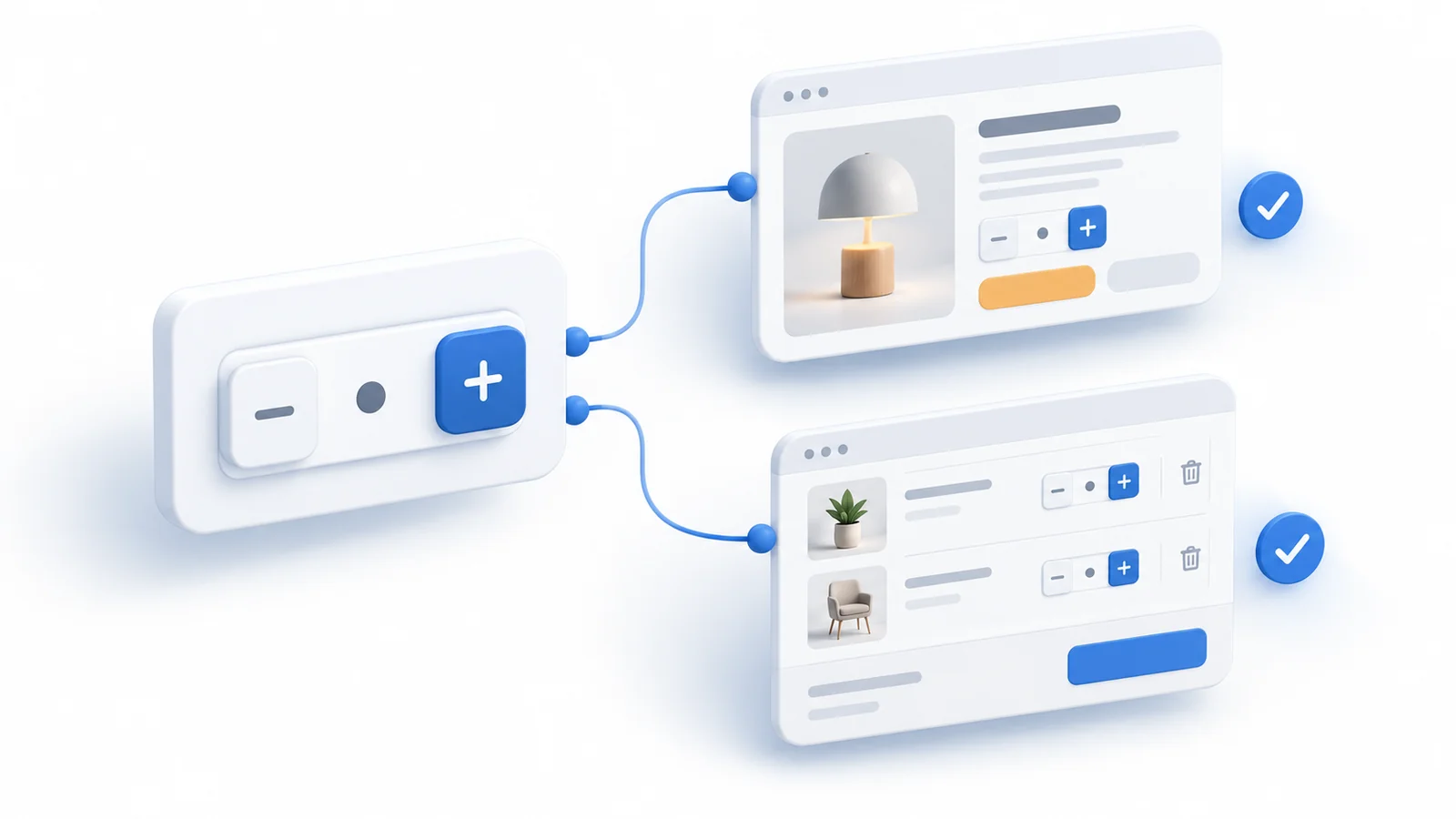
A quantity control appears on a product-detail page and again in the shopping cart. Both versions display a number between two buttons. A developer fixes how the control behaves at its upper limit, then a reviewer asks whether the team must repeat every quantity-control test on every page that uses it.
That question sounds like a discussion about test efficiency, but the more important issue is what the tests can legitimately prove. A shared control may correctly prevent an invalid increment while the product page still submits the wrong quantity. It may display a valid value in the cart while the server rejects an update and the total remains incorrect.
Copying identical button tests into every page suite makes a test collection bigger without necessarily making those integration failures more visible. At the opposite extreme, testing the shared component only once may leave essential product behavior unexamined.
The quantity-control scenario here is hypothetical. It is not a client incident, an implemented test suite, or a measured reduction in test time. I use it to show how I would decide where a behavior should be verified—and where a separate check earns its cost.
Start with the claim each test is supposed to support
A test is a piece of evidence about a particular claim under particular conditions. Before choosing a framework or adding another suite, state the claim: the control respects its bounds; the product page passes the chosen quantity to the add-to-cart action; the cart applies a server-confirmed quantity; or a customer can complete the journey in a real browser.
Those claims overlap, but they are not interchangeable. A component test that exercises a callback with the expected value does not prove that a page connects the callback to the correct request. A page-level test with mocked responses does not establish that the deployed API accepts the operation. An end-to-end test of one successful purchase path does not cover every error state of a reused control.
Testing Library’s guiding principles emphasize observable behavior that resembles how people use the interface, rather than inspecting a component’s internal methods or state. That is useful guidance across all these levels. It does not mean every meaningful assertion must run through a complete browser journey; the environment must be capable of supporting the claim being made.
I use a simple rule: test a stable behavior at the lowest level that can actually demonstrate it, and test each integration where context can change the result. “Lowest” is not a requirement to mock away the behavior being evaluated; it is a way to avoid proving the same narrow fact repeatedly in expensive places.
Define what the shared component owns
Assume an illustrative QuantityControl accepts the current value, minimum and maximum allowed values, a pending or disabled state, and a callback requesting a new value. The surrounding page is responsible for deciding whether that request changes a product selection or a saved cart line.
For this controlled-component design, the shared contract covers what appears, which actions are available, and what it requests when the user interacts. Representative checks would establish that increment and decrement requests stay within the supplied limits, controls expose meaningful names, disabled or pending states prevent unintended actions, and focus remains usable when the parent updates the value.
If the actual component manages its own state, validation, formatting or asynchronous work, its contract is different and its tests must cover those responsibilities too. The purpose is not to impose one architecture. It is to describe the existing boundary honestly enough that both implementers and reviewers know what a passing test means.
Shared props also produce meaningful combinations. Checking the default value does not prove that minimum and maximum limits, a pending state and a changed label interact correctly. A small decision table of allowed states can be more informative than dozens of screenshots with different product names. Conversely, exhaustively generating every combination is unnecessary when variants are independent and low risk.
Put different claims at different boundaries
I would make the testing plan visible as a coverage map rather than as a quota for every page. Each row identifies the confidence being purchased and, just as importantly, what remains outside its scope.
| Test boundary | Evidence to keep | Still unproven |
|---|---|---|
| Shared control | Limits, disabled state, labels and requested values | Correct page request or saved state |
| Product-page adapter | Chosen quantity and product identity reach add-to-cart | Cart storage and confirmed total |
| Cart integration | Accepted or rejected update reconciles line and total | Page-to-cart browser journey |
| Selected browser journey | Product selection becomes a confirmed cart line | Every variant, locale or failure path |
| Visual / accessibility review | Representative layout, focus and feedback checks | Business correctness or full accessibility |
A source-level function test may be appropriate for pure boundary calculations. A rendered component test is better evidence for a button’s name, focus or disabled state. A consumer integration test proves the page sends the intended information to the next boundary. A browser journey verifies that those layers work together on a relevant deployed configuration. No single one replaces the rest.
Storybook’s interaction-testing guidance provides one practical way to render components with controlled initial states, simulate interactions and assert outcomes. Its documentation also distinguishes render, interaction and visual checks. Storybook is an option, not a requirement: the coverage decision should survive a change of tooling.
Each consumer should prove its own responsibility
Return to the product page and cart. The product-detail page uses the same QuantityControl to gather a requested amount before adding a product. A meaningful integration check sets the quantity to three, activates the add-to-cart action, and verifies that the page sends the correct product identity and requested quantity to its own application boundary.
The cart has a different job. A cart line represents a saved state that can be accepted or rejected by the commerce service. When the visitor requests a new quantity, the application may show an in-progress value, wait for confirmation, update totals, or restore the previous quantity with a useful error. The cart needs evidence of those decisions. Repeating every increment/decrement limit check inside that integration suite would not address the central risk.
The same rule applies if the control appears in three recommendation cards or several product-detail layouts. If those consumers invoke one identical adapter under the same conditions, there may be no reason to reproduce the complete set of tests for each one. But differences in permissions, data mapping, locale, server ownership or legacy markup can change the contract and justify targeted checks.
A good consumer test therefore looks like a small interface agreement: given valid control output, does this host translate it into the correct request, state transition or navigation? It should not turn the shared component into a black box that magically guarantees all subsequent behavior.
Reserve a full journey for what cannot be proved in isolation
For a high-value commerce path, one browser scenario might start on the product page, select a quantity, add the product, navigate to the cart, and confirm that the server-backed line and total reflect the accepted state. That is a cross-boundary claim; it belongs in a more integrated test because the risk lives in the transitions.
A second targeted browser scenario might exercise a rejected cart update if that recovery behavior is particularly consequential and cannot be faithfully demonstrated with a thinner integration harness. It would be wasteful to test every QuantityControl visual variant through every checkout journey. It would be unsafe to skip a critical server-rejection path merely because the shared control’s button tests are green.
Playwright’s testing guidance recommends verifying user-visible behavior and keeping tests isolated from each other. Isolation matters here: one passing checkout test must not rely on the cart state left behind by another. Where data, authentication or service responses are controlled for repeatability, the team should be explicit about what is real and what is stubbed.
This is not an argument for one end-to-end test per application. The appropriate number depends on failure consequences, distinct integrations and the environments used. Some behavior earns a real-browser check for focus, responsive layout or cross-service interaction. Other behavior is better tested earlier with fast, precise feedback.
Screenshots and accessibility checks answer different questions
Visual regression tests can catch unintended changes in spacing, clipping and appearance. They can be valuable for a shared control used across design-system themes, narrow screens and right-to-left layouts. But a matching screenshot cannot demonstrate that a cart request was accepted or that an error was announced at the correct time.
Playwright’s visual-comparison documentation also cautions that rendering differences across operating systems, browser versions and environments affect baselines. A useful screenshot suite therefore needs representative states, stable conditions and deliberate review of changes—not automatic acceptance of every new snapshot.
Semantic checks have their own limits. An accessible name or accessibility-tree snapshot can establish that important properties are exposed, but that is not identical to confirming focus behavior, keyboard navigation, screen-reader feedback or task completion in the full page. The W3C’s accessibility evaluation guidance is explicit that automated tools cannot determine accessibility on their own; knowledgeable human evaluation remains necessary.
For the example, I would verify accessible button names and boundaries in the shared control, then check the product page and cart wherever focus, status messages or dynamic updates depend on their hosting context. That separates a component-level accessibility contract from the complete user journey, without treating them as unrelated.
Passing a component-level accessibility check does not automatically prove the full task is usable, as An Accessible Component Can Still Create an Inaccessible Journey demonstrates.
Change the evidence when the change moves the risk
A practical test strategy needs a rule for maintenance. When a component changes, ask which boundary now carries new uncertainty. A pure icon-spacing adjustment might call for focused visual review of representative responsive states. A changed minimum-value rule needs contract checks and targeted consumer assertions where bounds are configured differently. An updated cart persistence rule needs integration and possibly browser-level recovery evidence.
The following matrix is an illustrative change-review aid. It is not an automatic rule that every repository or architecture has the same test types.
| Change | First useful checks | When to widen coverage |
|---|---|---|
| Control limits or labels | Shared contract states and focused interaction | Consumers pass different constraints |
| Product-page mapping | Correct product identity and amount sent | Add-to-cart crosses a new service boundary |
| Cart update behavior | Acceptance, rejection, restored state and total | Live service or async sequence changed |
| Responsive style or RTL | Representative visual and keyboard review | Host CSS or locale changes rendering |
| Shared component API | Updated contract plus affected consumers | A consumer uses legacy markup or unusual state |
This matrix also helps reviewers see when apparent duplication is justified. Running the same component interaction in two different browser engines may be useful if there is evidence of an engine-specific issue. Repeating the same DOM assertion on five routes under identical conditions is less likely to improve confidence. The relevant question is whether the duplicate run can fail for a distinct reason.
When a change modifies the component’s public contract, its downstream consumers deserve a fresh check even when their own source files are untouched. Conversely, a change contained within one consumer does not automatically require every shared-component state test to run again in the reviewer’s mental model, although CI may execute broad suites for practical reasons.
Keep test evidence attached to the decision
A pull request summary should tell a reviewer which observable behavior changed, which invariant remains protected by shared tests, which consumer contracts were checked, and what was verified in a real browser or environment. It should also disclose a significant untested variation rather than implying that passing automation covers every context.
For the hypothetical cart change, that could be a concise statement: “The shared control still requests values within configured bounds. Product-detail integration confirms the requested quantity reaches add-to-cart. Cart integration covers server acceptance and rejection; the browser journey checks the persisted line and displayed total. Right-to-left focus behavior remains under manual review.” This is an example of evidence-oriented communication, not a claim that those tests were actually run.
Coverage percentages and counts are still operationally useful for spotting missing execution or sudden drops. They are weaker as arguments about which customer failures can occur. A large number of green tests may include many repetitions of one fact, while a single omitted integration check can leave the most consequential behavior unexamined.
The goal is neither minimal testing nor maximum test volume. It is a proportionate evidence set: fast feedback for shared invariants, small checks at genuine integration boundaries, and a few carefully chosen journeys for risks that emerge only when the pieces run together.
Reuse the confidence, not the assumptions
A shared component earns reuse because its responsibility and contract can remain stable across consumers. Its tests should follow the same principle. Verify the behavior once where it truly belongs, and do not ask that result to prove facts that depend on each host application.
When teams make this boundary visible, they avoid two expensive mistakes: repeatedly proving a button works while ignoring what the action does, and assuming a working button means a working customer journey. The strongest testing plan can explain not just which tests exist, but why each one might fail for a different reason.
That is how shared UI can stay genuinely reusable without making the release decision depend on repeated tests that all answer the same question.
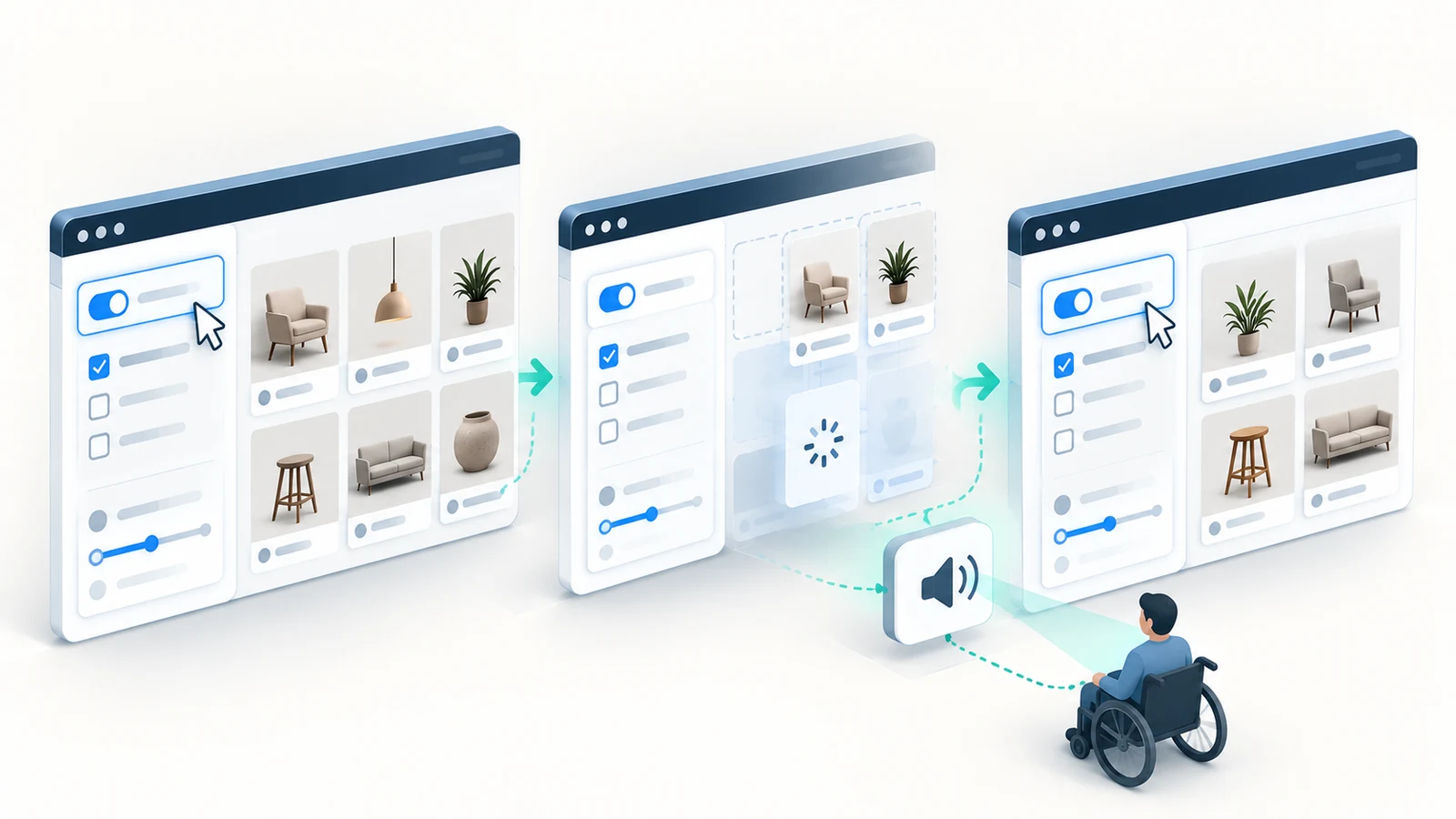
An Accessible Component Can Still Create an Inaccessible Journey
Accessible buttons and checkboxes are only the beginning. A practical look at focus, status announcements, stale responses, empty results, and the transitions that make dynamic interfaces usable.
Read article
The Release Risk Hidden Inside a Small Frontend Change
How to evaluate impact when a new interface must coexist with an older one
Read article