Documentation That Survives a Team Handover
A comprehensive wiki can still leave the next engineer stuck. Learn how to document the path from problem to safe change—and test whether the handover works.
On this page
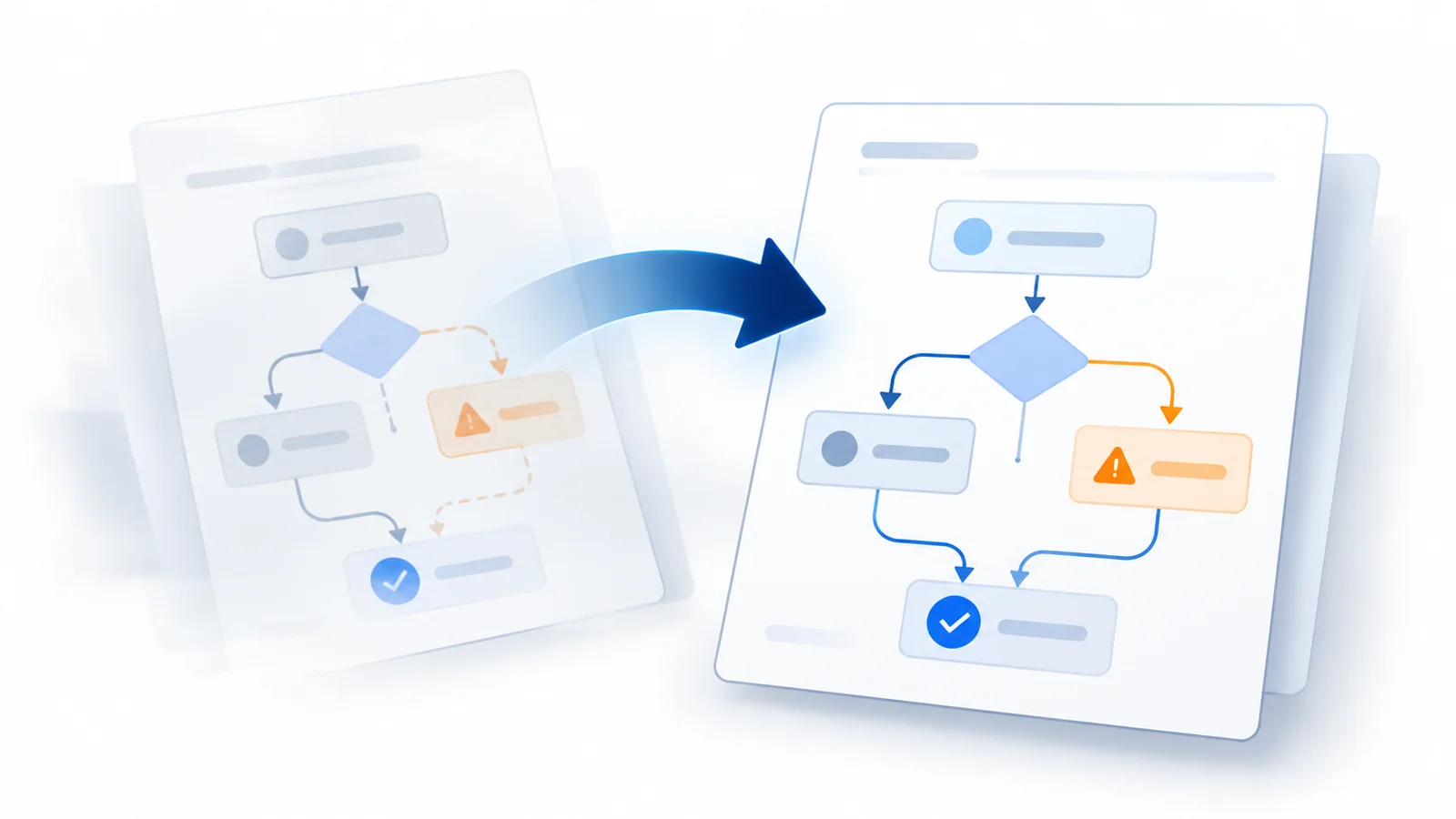
A project can have an architecture diagram, a long README, and recordings of every knowledge-transfer meeting—and still become difficult to maintain the moment one developer leaves. The missing knowledge is often not a file path or a command. It is the reasoning that connects an unexpected symptom to the next safe action.
Consider a hypothetical multilingual commerce website. An editor corrects a shipping statement in the content management system. The English page updates, but the Arabic page continues to show the old statement. The engineer who built the publishing flow is no longer on the team. The new engineer can start the frontend locally, yet cannot tell whether the problem is the Arabic content state, an API response, cached HTML, a deployment trigger, or a fallback rule.
A general system overview may describe all five components without helping anyone distinguish among them. The engineer needs to know where to observe the actual state, which component owns each responsibility, which changes are reversible, and how to verify that both languages show the intended content.
This scenario is illustrative, not an account of a client incident or a measured team outcome. It offers a more useful standard for handover documentation: could a qualified engineer who did not build the feature reach an evidence-based decision without relying on the absent author?
The handover test is a task, not a page count
A document is useful because of the work it enables. A new team member may need to understand the product, reproduce a defect, make a routine change, investigate a failed release, or decide whether the system is safe to operate. Those are different tasks. One exhaustive project wiki is not automatically the best interface for all of them.
GitHub’s README guidance describes a README as a first place to explain what a project does, how to begin, where to get help, and who maintains it. That is a good entry point. It is not an argument that installation commands, architectural rationale, incident recovery, and ownership should all live in one endlessly growing file.
In the fictional shipping-content example, a successful handover means the successor can locate the relevant page and content record, reproduce the discrepancy safely, follow the publishing path, distinguish the responsible layer, propose a proportionate fix, and verify the result. If access or evidence is missing, the successor should know whom to involve and what not to change.
The acceptance criterion is not “the new engineer read the documentation.” It is “the new engineer can use it to complete a representative task—or expose the exact gap preventing that task.” The distinction moves the conversation from document completeness to operational readiness.
Document the route from symptom to decision
The strongest starting point is not an inventory of tools. It is a map of the questions a maintainer will actually face. The map needs enough context to orient someone unfamiliar with the project, but it should lead toward evidence and responsibility instead of duplicating every implementation detail.
For an application with a CMS, frontend, API, and deployment pipeline, I would organize the handover around five capabilities: orientation, reproduction, safe change, recovery, and decision context. Each has a different durable source of truth.
| Handover capability | Primary artifact | Question it answers |
|---|---|---|
| Orientation | README + system map | What runs where, and who owns each boundary? |
| Reproduction | Repro guide + test fixtures | Can I observe the problem without changing production? |
| Safe change | Contributor guide + checks | Which workflow validates a proposed fix? |
| Recovery | Runbook + escalation path | How do I act, stop, roll back, or obtain approval? |
| Decision context | Architectural decision records | Why does this constraint exist, and when can it change? |
This division is deliberate. A repository README is close to the code and can explain how to run and contribute. A small architecture map tells a newcomer which systems own a behavior. A runbook offers a controlled response to a known operational condition. A decision record preserves the reason behind a constraint that otherwise looks arbitrary.
None of those artifacts should be copied into four separate versions. If an instruction has one authoritative location, other documents should point to it. If there are conflicting versions of how deployment works, the handover package may increase uncertainty rather than reduce it.
A runbook should begin with evidence and include stop conditions
Return to the content problem. The old shipping statement appears only on the Arabic production page. A weak runbook says, “Clear the cache and redeploy.” That may accidentally fix a symptom, but it does not establish the cause. A broad purge might affect unrelated pages, and a redeploy may be unnecessary if the source content is still unpublished.
A more useful procedure begins with a precise trigger: the published content differs from what a user sees at a named route and locale. It identifies the environment, the expected behavior, the least-privileged access needed, and the observations that separate plausible explanations.
First, inspect the Arabic record and its publication state in the CMS; do not assume that the English and Arabic entries share a publishing state. Then compare the content returned through the relevant delivery API or published artifact with the rendered Arabic page, using an authorized read-only method. If the content source still contains the old statement, investigate editorial state or locale mapping. If the source is correct and the page is stale, investigate the actual rendering and caching path. These branches are hypotheses, not claims about a particular framework.
Only after identifying the affected layer should the runbook offer a change: correct the content record, revalidate the specific page, or invoke the documented build or deployment process, as appropriate for the verified architecture. It should name the permission boundary, approval owner, and rollback or recovery action. It should also say when to stop—for example, if the relevant content differs across environments, the action would invalidate unrelated customer pages, or the engineer lacks the required approval.
Finally, verification must cover the customer-visible result, not merely a successful command. Check the exact Arabic route, the English route for unintended change, the delivered content, and any required regional or cache variants. Record the evidence and the decision taken. The runbook has done its job when it narrows a decision and creates a safe, inspectable outcome.
Microsoft’s guidance on standardizing operations recommends actionable procedures, versioned documentation, periodic review, and consistent processes for routine and emergency work. The principle here is similar: a runbook is a decision aid under constraints, not a collection of reassuring commands.
Preserve why the architecture is the way it is
When teams hand over code, they often document the current design but not the options that were rejected. A successor sees a translation fallback, custom cache invalidation rule, or an extra deployment step and reasonably asks whether it is unnecessary complexity. Without context, removing it may restore an old failure.
An architecture decision record can close that gap when the choice is material. AWS’s ADR guidance defines these records around the decision, its context, consequences, and lifecycle. A concise record can explain the constraint being protected, the alternatives considered, the trade-off accepted, and the conditions under which the decision should be revisited.
Imagine that the fictional application intentionally uses a separately reviewed publishing workflow for shipping statements because the text has operational significance. An effective record would not simply say “manual approval required.” It would explain which content is subject to the approval, who can authorize changes, why automatic publishing was rejected, what that delay costs, and what evidence might justify a simpler approach. It would distinguish a current policy from an irreversible technical law.
Decision records should not become a diary of every minor implementation choice. I would reserve them for decisions whose absence is likely to cause repeated debate, unsafe simplification, or expensive rework. Superseded records can remain discoverable so the next engineer knows whether an old limitation is still active.
Ownership, access, and expertise are separate questions
A handover fails quickly when responsibility is represented only by the name of the developer who used to know everything. The successor needs at least three answers: who decides a change is acceptable, who can review its implementation, and who is permitted to perform an operational action. These may be different people or teams.
For code changes, GitHub’s CODEOWNERS mechanism can request review from designated owners, and repository rules can require an appropriate approval. That helps route code review; it does not, by itself, establish production access, incident command, or product policy authority. Those responsibilities require their own explicit owner and escalation path.
The handover should also identify how authorized engineers request missing access and where credentials are managed. It should never put live secrets, private keys, personal tokens, or recovery codes into a document merely to make onboarding convenient. Document the process for obtaining and revoking access, the role required, and who approves it—not the secret itself.
For a multilingual content incident, the frontend maintainer might diagnose a cached page but need an editorial owner to confirm the intended wording and a platform operator to approve cache invalidation. A useful handover shows those boundaries before an urgent change, not during a confused production call.
Rehearse the handover while the original engineer is available
The most revealing documentation review is a controlled attempt to use it. Ask a capable engineer who has not built the feature to complete a representative maintenance task with the written materials. Observe where they search, what they assume, which commands fail, and which decisions require an undocumented conversation. The original owner can answer questions after the exercise, but should avoid narrating every step.
For the example system, I would test both routine maintenance and a degraded condition. A new engineer should be able to start the application, trace the published content to the page, make a change in a safe environment, and explain how they would respond to a stale production page. The goal is not to stage a theatrical outage. It is to test the path people will need when the author is absent.
| Handover exercise | Evidence of readiness | A gap worth fixing |
|---|---|---|
| Start in a clean environment | App and fixtures run using documented steps | Hidden setup command or missing dependency |
| Trace Arabic publishing | Source record, API state, and rendered route compared | Unknown locale mapping or stale architecture map |
| Propose a safe correction | Scope, permissions, reviewer, and tests identified | Owner unclear or change cannot be verified |
| Simulate recovery | Stop condition, rollback path, and escalation explained | Runbook assumes author-only access |
| Verify user-visible outcome | Arabic updated; English unaffected; evidence recorded | Green build mistaken for completed customer outcome |
The table is a suggested rehearsal, not a universal certification standard. If a production action is high risk, the engineer can demonstrate the decision and required approval in a non-production environment or simulation rather than touching live systems. The reviewer should record specific missing links, inaccessible environments, ambiguous steps, and unclear owners—not a vague score for “knowledge transfer.”
A failed handover points to different kinds of work
The rehearsal should produce more than a pass-or-fail verdict. I would classify each blocker before deciding what to repair. If the right document exists but cannot be found, the defect is discoverability. If its instructions no longer match the system, the defect is accuracy. If no one can authorize an action, the defect is decision ownership. If the successor cannot obtain an approved role, the defect is access management. And if the relevant state cannot be observed or safely changed even with correct instructions, the defect may be in the system’s operability. All five appear as “the new engineer got stuck,” but adding more pages only addresses some of them.
For the Arabic shipping-content example, a successor who can prove that the published API response is correct but cannot determine why the page remains stale needs an observable cache or rendering path—not another description of the CMS. A successor who identifies the correct recovery action but cannot execute it without production privileges may be acting exactly as intended; readiness means knowing the authorized escalation, not bypassing it. I would record the blocked step, the evidence already gathered, the required owner, the smallest safe remedy, and the verification that would show the remedy worked. Then I would repeat the same task with the corrected materials or system. That retest separates a documented handover from a usable one.
Google’s SRE discussion of on-call work emphasizes clear escalation paths, incident procedures, and the ability to make deliberate decisions under pressure. A handover exercise brings that principle forward: it is less costly to discover an undocumented dependency during a controlled rehearsal than while diagnosing a user-facing problem.
For shorter, day-to-day transfers of responsibility, Distributed Teams Need Decision Handoffs, Not More Meetings looks at the same problem from the receiving engineer’s perspective.
Keep documentation current by attaching it to the work that changes it
The hardest documentation problem is not writing the first version. It is knowing which statements become false after a release, platform migration, configuration change, or team reorganization. A document that was accurate six months ago can be more dangerous than an obvious missing page if it confidently instructs someone to run the wrong procedure.
Rather than assigning one person to periodically rewrite a giant wiki, attach specific maintenance triggers to the owning artifacts. A change to a setup command should update the repository’s getting-started guide. A changed dependency or architectural rule should update the system map or supersede the relevant decision record. An altered deployment or rollback path should change the runbook in the same work item. A new service owner should update the escalation path.
Automated checks can help where truth is machine-verifiable: validate links, run documented setup steps in a clean environment, or keep command snippets executable in CI when feasible. They cannot certify that a decision’s rationale remains sound or that an escalation contact is still accountable. Those need human review at meaningful change points.
Keep metadata lightweight: owner, last verified date when useful, source-of-truth link, and the event that should trigger another review. A review date is evidence of attention, not proof of present accuracy. Prefer a short, tested procedure with clear boundaries over an impressive document whose claims no one has recently used.
Use proportionate documentation, not maximum documentation
A small internal utility with straightforward deployment does not need the same transfer package as a revenue-critical website with many integrations. Documentation has a maintenance cost. Every additional page introduces another claim that may drift from the code or operating reality.
I would prioritize work according to the consequence of a wrong decision, how often the task occurs, how easily the answer can be rediscovered, and how dependent the team is on one person’s memory. High-impact rollback instructions, data ownership rules, external interfaces, and approval boundaries usually deserve explicit treatment. A minor styling convention already enforced by tooling may not.
Sometimes the right fix is not more prose. It is automating an error-prone manual command, reducing permissions, making logs easier to trace, adding an integration test, or simplifying an unnecessarily hidden dependency. If the handover repeatedly requires a specialist to explain the same fragile step, the system itself may need to change.
A handover is complete when the next engineer has a safe path
Good documentation cannot eliminate every question, and it cannot replace qualified engineering judgment. It can make an unfamiliar system legible enough that the next person knows where to look, what evidence matters, who decides, which actions are reversible, and where responsibility must change hands.
That is the standard I would use before calling a handover complete: not the number of pages produced, but whether a successor can investigate a realistic problem, carry out or propose a safe change, and demonstrate that the expected behavior is restored. Any failure in that exercise becomes a concrete improvement to the documentation, the access model, or the product.
The document survives the handover when the team no longer needs its author to turn observations into responsible action.
Distributed Teams Need Decision Handoffs, Not More Meetings
A status update can be accurate yet leave the next engineer blocked. Learn a practical decision-handoff method for remote software teams without adding unnecessary meetings.
Read article
How to Support a Technical Recommendation with Evidence
An engineering solution can sound convincing and still be poorly justified. A practical method for separating symptoms, causes, competing options, and verification using a hypothetical shopping-cart improvement.
Read article