A Risk Register That Helps Engineers Make Decisions
A useful risk register does more than rank concerns. See how one hypothetical checkout release uses observable triggers, tested controls and decision ownership to guide what ships.
On this page
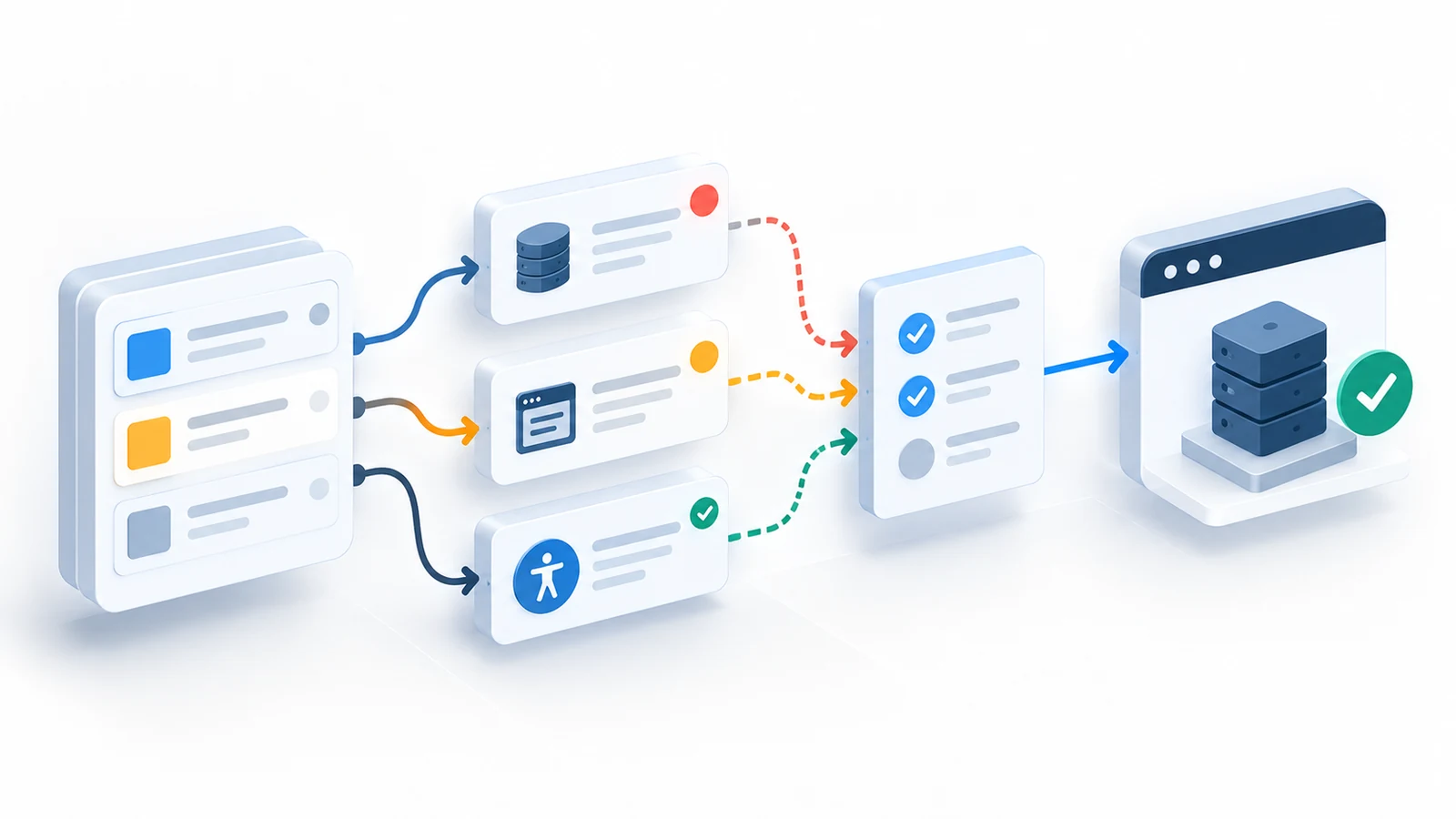
An e-commerce team is preparing to release a new delivery-cost estimator during checkout. The frontend will request a quote when a shopper changes the delivery address, then display the amount before the order is confirmed.
The release raises several reasonable concerns. An old network response might overwrite a newer quote. An error message might be invisible to someone using the keyboard or a screen reader. A shared style change might interfere with an existing checkout template.
A risk register could list these under “Technical,” “Accessibility,” and “Compatibility,” assign colors, and be considered complete. Yet the release team would still lack the information it needs: What is actually known? What would make us stop the release? Which check can reduce the uncertainty? And who can authorize proceeding with what remains?
The checkout scenario here is hypothetical—not an incident, implementation, or test result from a client project. I use it to explore how risk management can become a practical part of frontend delivery, rather than an administrative exercise.
A risk register should lead to a decision
A useful entry changes something: the order of work, the scope of testing, the need for a fallback, the involvement of another team, or the conditions under which a release can proceed. If a row cannot influence any decision, it deserves to be challenged or simplified.
This does not mean every risk must block a release. Most software delivery involves uncertainty. Avoiding all uncertainty is neither realistic nor desirable. The purpose is to understand which possible failures matter, what can be done before they occur, and what level of remaining exposure the people responsible for the product are willing to accept.
NASA’s technical risk management guidance treats risk management as a continuous process of identifying, analyzing, planning, tracking, controlling, and communicating risk; it also connects monitored thresholds to mitigation and contingency actions. The UK government’s Orange Book similarly makes risk part of evaluating options and making decisions, rather than a separate reporting ritual.
These sources describe larger governance settings than a typical frontend team needs. Their transferable principle is straightforward: the record should support action and accountability, not become a document that merely proves someone thought about risk.
Describe an uncertain event and its consequence
“Delivery API risk” is a topic, not an actionable risk statement. “Checkout might break” names an anxiety without helping the team reason about it. A better formulation connects a condition, something that could happen, and the harm that would follow.
For the illustrative checkout: If delivery-quote requests can finish out of order, an earlier response could replace the quote for the customer’s most recently selected address, potentially presenting the wrong amount before confirmation.
This statement identifies an engineering mechanism, the point of uncertainty, and why it matters. It also suggests ways to investigate the concern: simulate two requests that return in reverse order, inspect which response can commit state, and verify that the final order uses an authoritative amount.
The consequence matters more than the mere presence of asynchronous code. Many interfaces fetch data asynchronously without endangering a financial commitment. Here, the key question is whether the displayed price and the amount eventually accepted by the checkout system remain consistent.
Do not hide a known defect inside a risk score
There is a practical distinction between a risk, an issue, and an assumption. A risk concerns a possible future event whose occurrence or effect is uncertain. An issue is something already observed that requires handling. An assumption is a condition the plan depends on but has not yet confirmed.
Suppose the team runs the out-of-order-response test and sees an old quote replace the correct one. It is no longer useful to debate the probability that this particular behavior exists in the tested conditions. There is a reproducible defect. The team should track and correct it as an issue, while the register can retain the separate question of where similar behavior might remain unverified.
Similarly, “the backend always recalculates totals before purchase” is not a control simply because someone expects it to be true. Until the contract or test evidence confirms it, it is an assumption whose failure could affect release safety.
This distinction keeps the risk register honest. A potential problem needs investigation; a confirmed problem needs resolution or an explicit, appropriately authorized decision about its consequences.
Prioritize consequences without inventing precision
Likelihood and impact are relevant, but multiplying two loosely defined labels does not make the resulting number an objective measurement. Two teams might both call a risk “medium probability” while imagining entirely different scenarios. A rare event that compromises checkout correctness may deserve stronger controls than a frequent cosmetic problem, even if someone assigns them the same score.
I would first ask about the reach of the affected functionality, the credible consequence if the event occurs, the evidence supporting the likelihood judgment, how quickly the problem could be detected, and whether it can be reversed without customer harm.
Evidence quality belongs in this conversation. A hypothesis drawn from reading a shared component has a different basis from a failing integration test or production monitoring. Weak evidence does not always make a concern unimportant; it may make a short investigation the most useful next action.
The Orange Book explicitly recommends considering uncertainty, evidence limitations, dependencies, existing controls, and the consequences of different treatment options. The intention is proportionate judgment, not a universally correct risk formula.
A small register for an actual release decision
Here is a worked register for the hypothetical delivery-cost feature. The owners are roles, not real people. Each entry connects a possible consequence to a trigger and an action. The table does not assert that any of these failures has occurred.
| Possible event and harm | Trigger or evidence to examine | Response and owner |
|---|---|---|
| R1: An earlier quote could replace the amount for a newer address | Reverse response-order test; compare selected address with accepted quote | Frontend engineer: prevent obsolete commits; verify final authoritative amount |
| R2: Quote service could fail while shopper is confirming delivery | Simulated timeout and rejected quote; inspect fallback and recovery | Integration lead and product owner: agree safe failure behavior; avoid false confirmed amounts |
| R3: Quote error may not be understandable without sight or pointer | Keyboard and screen-reader test in failure and retry states | Frontend and accessibility reviewer: correct status feedback and usable next action |
| R4: Shared styling could disrupt an existing checkout page | Old and new template smoke checks with deployed asset combinations | Frontend lead: isolate styles; preserve critical totals and actions |
Notice that the first response is not always “fix the code.” It may be a targeted test, clarification of a service contract, or a product decision about safe behavior. That is still engineering progress because it reduces the uncertainty that affects whether the feature can be released responsibly.
A useful register can be compact. For most small changes, it does not need a full risk taxonomy, invented percentages, or a new reporting ceremony. What matters is that someone can tell which risks remain open and which action is expected next.
A mitigation is not complete because a task was marked done
Suppose engineers add request identifiers so a response can update the screen only when it matches the current delivery selection. The implementation reduces the chance of stale visible state. But it does not automatically prove that a confirmed order uses the correct tariff or that a retry after an error preserves the intended address.
The register should distinguish an intended control from evidence that it works. Its status changes when the relevant behavior has been verified in the conditions that matter, not merely when a pull request is merged.
Even after verification, some exposure remains. A dependency may still be unavailable; a fallback may rely on staff or another channel; an unexpected deployment state may not be covered by the tests. This remaining exposure is residual risk. It is not evidence of a failed project—it is a reason to decide explicitly whether the current controls and recovery options are sufficient.
Mitigations can also create new risks. Disabling an action during quote failures may prevent an incorrect purchase, but it may also block otherwise valid orders. Displaying an estimated amount may preserve progression but create a customer promise the business cannot honor. The choice requires product authority and a clear communication plan, not only a frontend implementation preference.
Make release decisions from evidence, not from color
A risk register becomes operational when the team agrees on decision gates: what evidence allows work to continue, what must be corrected, what warrants escalation, and what may be monitored after release. The following examples use no fabricated numeric thresholds; actual targets must come from the product’s tolerances and real operating data.
| Evidence at release review | Decision response | Evidence or owner required |
|---|---|---|
| Stale quote can reach the final confirmed amount | HOLD — correct as a reproducible defect | Engineering: fix request state and verify amount with backend |
| Essential quote error is not perceivable or recoverable via keyboard | HOLD — restore essential accessible path | UX/frontend: test failure journey with keyboard and screen reader |
| Quote service can fail, but an agreed safe fallback is implemented and tested | CONDITIONAL PROCEED — only under approved business behavior | Product owner accepts fallback; integration lead shows recovery tests |
| Old template has a contained cosmetic difference with no blocked action | MONITOR OR PLAN FIX — based on product impact | Owner records supported variants and regression follow-up |
| Key paths pass but tariff authority or financial rule remains unclear | ESCALATE — do not assume a safe business promise | Responsible business and integration owners confirm contract |
A successful test does not automatically turn every associated risk green. It establishes that a particular failure did not occur under the tested conditions. Reviewers still need to judge whether those conditions represent the supported browsers, checkout variants, data states, and deployment sequence.
Likewise, a non-blocking visual mismatch does not automatically deserve the same response as a wrong amount presented before purchase. The consequence and ability to recover are different. The register should help make that difference visible instead of treating every open row as equivalent unfinished work.
A related approach to exposing assumptions before approving a change appears in Reviewing a Technical Proposal: Questions That Expose Hidden Risk.
Assign ownership to the decision, not just the implementation
An engineer can own an investigation and implement a control. A QA engineer can own verification evidence. A product or business owner may need to decide whether a temporary restriction or altered delivery promise is acceptable. These are different responsibilities.
“Backend team” in an owner column is often too vague. It does not say who is expected to respond, by when, or who can decide if the service contract remains unclear. A useful entry identifies the next responsible role and a review point, with escalation when the decision sits outside the team’s authority.
The distinction matters most when a release deadline becomes tight. Technical staff should not be left implicitly accepting a customer-facing financial or legal trade-off merely because they can deploy the code. Equally, a business owner should not be asked to accept a risk without a clear explanation of its cause, likely consequence, and available controls.
Keep risk review connected to the delivery workflow
A register updated only before a status meeting will quickly become irrelevant. Review it when the scope changes, an integration contract becomes known, a critical test fails, a dependency slips, or a release decision is approaching.
If the risk describes a component shared across old and new pages, the linked evidence might be a focused compatibility test. If it depends on an external API, it might be an agreed contract and representative failure test. If it concerns inaccessible error feedback, the evidence should include the complete affected task, not just a passing automated scan.
Once a risk is closed, preserve why. Was the event prevented? Was its impact reduced? Was the feature removed from scope? Or was the remaining exposure accepted by someone authorized to make that decision? Those are materially different outcomes.
For a small team, a few linked items in the existing issue tracker may be enough. The useful measure is whether the record survives handover and informs the next decision, not whether it has its own dedicated software platform.
The register is useful when the plan changes
The strongest test of a risk register is not whether it looks complete on release day. It is whether new information causes the team to make a better choice. A failing test should redirect work. A verified assumption should remove unnecessary investigation. A new dependency should change ownership or release timing. A proven control should reduce the need for additional precautions.
A document that only records concerns after decisions have already been made adds little value. A short, current record that states what could happen, what evidence matters, who acts next, and which outcomes block or permit release can save far more effort than its upkeep costs.
That is how I would judge the quality of a risk register: not by the number of rows or the sophistication of its scoring scheme, but by whether it makes engineering choices clearer before the consequences reach users.

Reviewing a Technical Proposal: Questions That Expose Hidden Risk
A promising technical demo is not enough to approve an architecture. This practical review method turns hidden assumptions into specific evidence and an actionable decision.
Read article
Scope Changes Are Decision Changes: Managing Late Requirements
A small gift-message request can affect a whole checkout release. This article shows how to distinguish late clarification from new scope and make the trade-offs explicit.
Read article